Our Multi Technology Adventure
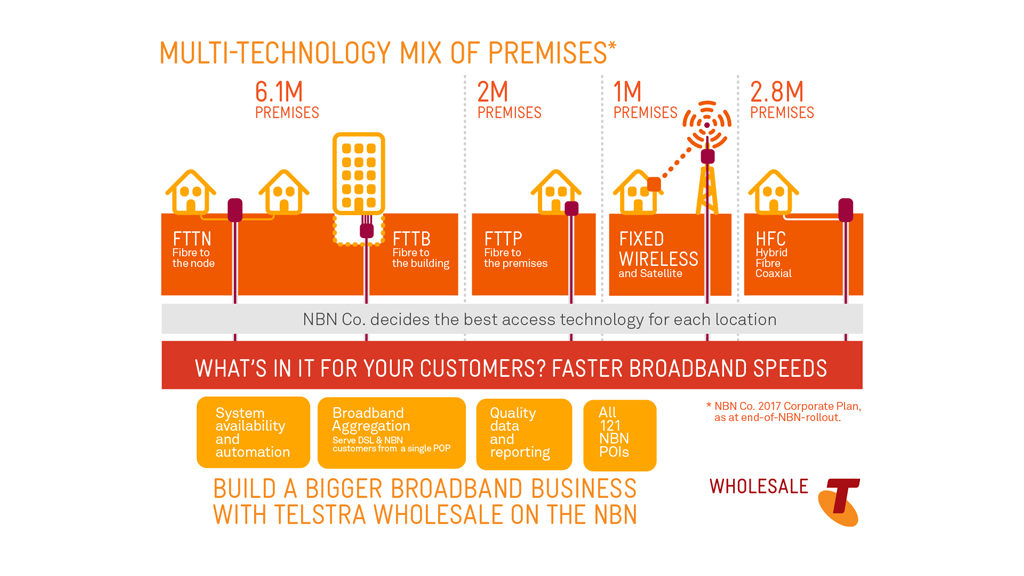
The Multi Technology Mix (MTM) is a term you’ll find closely associated with the National Broadband Network (nbn™). The NBN is now being delivered using a wider range of technologies than initially proposed. Fibre to the Building (FTTB) and Fibre to the Node (FTTN) have been added to the technologies already in use - Fibre to the Premises (FTTP) and Fixed Wireless. Hybrid Fibre Coaxial (HFC) and Long Term Satellite services are targeted for launch by NBN Co in the second quarter of this year, according to the NBN Co Integrated Product Roadmap as at January 2016. The combination of these six access types is referred to as MTM.
As the rollout gains rapid momentum and scale over the coming year and a half, there are a number of key considerations that we, as an industry, need to understand as this journey progresses.
The NBN is a huge adventure and a real test of our industry’s ability to automate and to innovate.
According to the NBN Weekly Progress Report current at 14 April 2016 over 932,000 premises have now been connected to the NBN, and the network has passed over 1.97 million premises. The 2016 NBN Corporate Plan suggests a target that by the middle of this year over two million premises will be ready for service, growing to around by five million by June 2017.
While the acceleration of the NBN rollout through the adoption of MTM is something to be congratulated, it also presents some challenges worthy of deeper consideration.
The first of these is what I call a multi carrier, multi technology environment. Customers who acquire services today from a variety of providers, whether standalone, naked or as a bundle, will now typically make a decision to select a single service provider on the NBN. This process is complicated further by multiple access technologies. There is a range of operational scenarios that arise under MTM and these scenarios differ slightly for each technology type.
As an industry, our IT capability and underlying processes need to be carefully engineered to accommodate a wide variety of use cases. Support for effective operational and transfer capability will be a key requirement. At Telstra Wholesale, we’re working very closely with industry, customers and the Communications Alliance in the development of industry codes to facilitate a common framework for this multi carrier, multi technology capability.
A second consideration is service activation and assurance. As more services are introduced on the network, there will be an even greater focus on delivering quality customer experiences, cost effectively. And with the introduction of the MTM, providing a consistent activation and assurance experience on the NBN becomes more complex.
In the assurance environment, we will be aiming to develop a B2B based capability to enable our customers to build to this function through their own fault management systems. This will provide a more streamlined process and integrated assurance functionality for our customers.
So for example, video delivered through the internet is “Game of Thrones” critical for the people who happen to be watching it. Poor quality service experiences for end users will critically impact on customer retention.

A third area, of particular interest to many of us, is capacity and bandwidth growth. We know there is rising demand for media rich content, software downloads and cloud services. The success of brands like Netflix, Presto, Stan and others has made delivering a quality broadband service even more important to customers.
According to the Australian Multi-screen Report, 32% of homes now have internet-capable TVs, and people aged between 13 and 24 view significantly more video on the internet than any other demographic range. The average 18-24 year old spends 36 hours a month watching TV in the home, and in addition, over 19 hours per month watching online video on a pc or laptop and just over 14 hours watching online video on a smartphone.
To satisfy customers’ demands here we need to deliver high quality and high availability services because customers are increasingly turning to the network (and not broadcasters) to deliver content of all types on demand.
The fourth factor to consider is how we deal with business services, with the way somewhat clearer as to how these will then migrate to NBN.
We are rounding out our NBN offerings to support business services. Our first focus area is business voice, developing a multiline business voice capability. This product will be available via a number of access types, including NBN. We’re also exploring Ethernet access integration into NBN for support of business services.
In the backhaul space, traffic is expected to grow substantially in the next year or so driven by the volume of connected users and the increased average peak user speed. We are developing several capabilities to give flexible transport and connectivity to NBN point of interconnection (POI) sites.
At Telstra Wholesale we are working very hard to expand our product roadmap to support NBN access for business services. We are also taking the opportunity to ensure that the products we develop are well suited to current market requirements – focusing on fewer products endowed with more modern capabilities.
The forward-looking product roadmap
The rollout of the MTM is an exciting development for everyone involved. Each access type has operational differences, due to the underlying technology, but we are committed to the goal of maintaining a consistent experience for our customers.
With increasing acceleration in the rollout of the NBN over the coming 18 months, our roadmap is embracing multiple technologies, aimed at delivering consistent products to support the anticipated growth of connections and bandwidth over the next few years: our MTM adventure is already underway.

For more information, read our discussion paper "Powering Growth in an Evolving NBN Environment"
Download the Discussion Paper